

Helen Elizabeth Kuumbi |Artist| Cornwall
Trethevy Quoit
Neolithic Portal Dolmen, near Darite, Liskeard, SE Cornwall Grid reference: SX 25935 68813
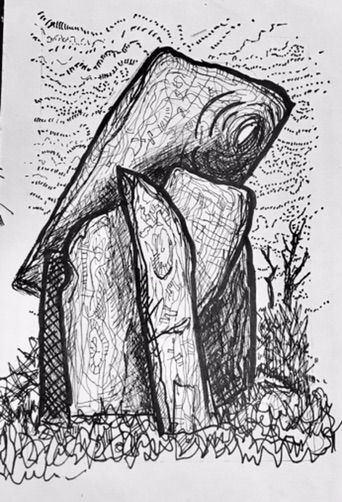
Trethevy Quoit is amongst the most spectacular of British dolmens: with its mammoth 20 tonne capstone, huge uprights and the curious features of the drilled circle and the small cut entrance-way in the door-stone. It’s closeness and accessibility has enabled me repeat visits over the years, and the ability to explore further it’s textures and sculptural form a little closer each time. The Quoit seems, however, incongruous with its context: nestled in the corner of a small meadow behind a row of houses: you are up close immediately upon entering the field. Here, it is hard to get a sense of the wider landscape.
The dolmen sits just south of the slight peak, on a spur of land, which falls steeply either side to streams. The waters will join to become the river Seaton. Sat with a map, I striped away the maze of the human-built world, and looked at the contours, waterways and orientation – the location reminded me of Mulfra Quoit. I have wondered what the view would have been before the hedges and houses, but reminded myself that some of the Cornish- hedges may be millennia old.
To the north Its neck narrows, widens and then rises up to the rough ground of Craddock moors – a playground of prehistoric remains muddled by mining.

Extant Archeology
Trethevy quoit is a portal dolmen, constructed between 3500-3000BC. The capstone is balanced at a tilt on top of six uprights, one which divides the enclosed chamber from a small forecourt. There is a low platform of green stones, approximately 25m long by 10m wide. There is little of the same type of stone found elsewhere in the field – not enough material to form an enclosing cairn. It is thought that rather than being completely buried, parts of the dolmen including its capstone would have been left visible.
There are a dozen or so quoits surviving in Cornwall, only three are considered true portal dolmens: Zennor, Trethevy and Pawton. Mainstream archelogy has long described these types of monuments as chamber tombs, however more recent studies challenge whether this was their primary function. Some authors suggest that the raising and balancing of these massive capstones an intentional way of showing the great stone, and of displaying the skill of the builders. See Richards and Cummings 'Monuments in the Making: Raising the Great Dolmens in Early Neolithic Northern Europe' for a deeper dive into this.
History and Folklore
The quoit is also known as ‘The Giants House’. It was described this way by the cartographer John Norden in 1584 and his records give us our earliest description of Trethevy Quoit:
"Called in Latine Casa gigantis, a litle howse raised of mightie stones, standing on a little hill within a fielde… The cover being all one stone is 16 foote in length, the bredth is 10 foote, the thickness is 2 foote; an artificial holl 8 inches in diameter made through the roof very round, which served as it semmeth to putt out staffe, where of the house it selfe was not capable: F was the dore or entrance".
Norden believes that the hole is a place for a flag pole through the roof of a house. He also provides us with the earliest illustration of Trevethy.
The impressive structure was recorded by Wiliam Copeland Borlase's in his 1927 ‘Naenia Cornubiae’, and Lukis and Borlase surveyed the site in 1879.


Solar alignments and interesting features
There is drilled hole in the capstone of Trethevy Quoit– this is a feature that is not present in other Cornish quoits. There has been speculation to its purpose. Carolyn Kennet, of Archaeoastronomy Cornwall, theorises that holed stones enabled the observation of the sun indirectly, therefore protecting vision. At the quoit, a solar alignment is observed: when the sun reaches its zenith during the summer months it shines directly through the hole casting a sun beam onto the ground below. This occurs on the summer solstice at noon.
Another feature is the small entranceway cut in the dividing stone between the chamber and forecourt – it is not known if this was contemporary to the structure or created at a later date. This is not a feature on other dolmens in the South West, however there is an angular ‘entrance’ in the door to Chun Quoit, although considerably smaller so that only a small child could enter.
The weathered faces, quartz lines and rough faces suggest intentional choice and placement of the stones. Potential rock art has also been documented: cup marks on the capstone, however I have yet to spot this
Excavation
2019 Cornwall Archeology Unit investigated a number of geophysical anomalies around the monument. One of these was a platform of quarried greenstone that had been brought to the site from the local area.
An examination of the rocks shows that the top of the capstone had distinctive veins of quartz and a weathered surface – it had it been the top of tor. The uprights were granite from the same source.
A number of test-pits were dug in the field across the field, targeting anomalies but yielded little archaeological material. A hammerstone and two flints were found.

Explore further
Holed stones and solar alignments:
Heritage Gateway listing:
Norden, J. (1728). Speculi Britanniae Pars: A Topographical and Historical Description of Cornwall. Printed by William Pearson for the Editor. page 88. Digitalised copy accessed at: https://www.google.co.uk/books/edition/Speculi_Britanniae_Pars/53tbAAAAQAAJ?hl=en&gbpv=1&dq=john+norden+cornwall&printsec=frontcover
Article on John Norden with his illustrations :https://www.cornwallheritage.com/ertach-kernow-blogs-2020-2021/ertach-kernow-john-norden-revealing-the-face-of-tudor-cornwall/
Cornwall heritage trust: https://www.cornwallheritagetrust.org/our_sites/trethevy-quoit/
Excavation report by Cornwall Archaeology unit : file:///C:/Users/User/Downloads/Investigations_at_Trethevy_Quoit_2019_th.pdf
Cummings, V., & Richards, C. (2021). Monuments in the making: Raising the great dolmens in early Neolithic northern Europe. Windgather Press.
Wetherill, Craig (2009) Cornovia Ancient sites of Cornwall and Scilly 4000BC-1000AD, Wellington, Halsgrove,
Cummings, Vicki, and Richards, Colin. The Essence of the Dolmen. Fonctions, Utilisations Et représentations De l’espace Dans Les sépultures Monumentales Du Néolithique européen, Presses universitaires de Provence, 2016, https://doi.org/10.4000/books.pup.4923
Kennet, C (2022) Sites of prehistoric Bodmin Moor, Cornwall stargazers.


